
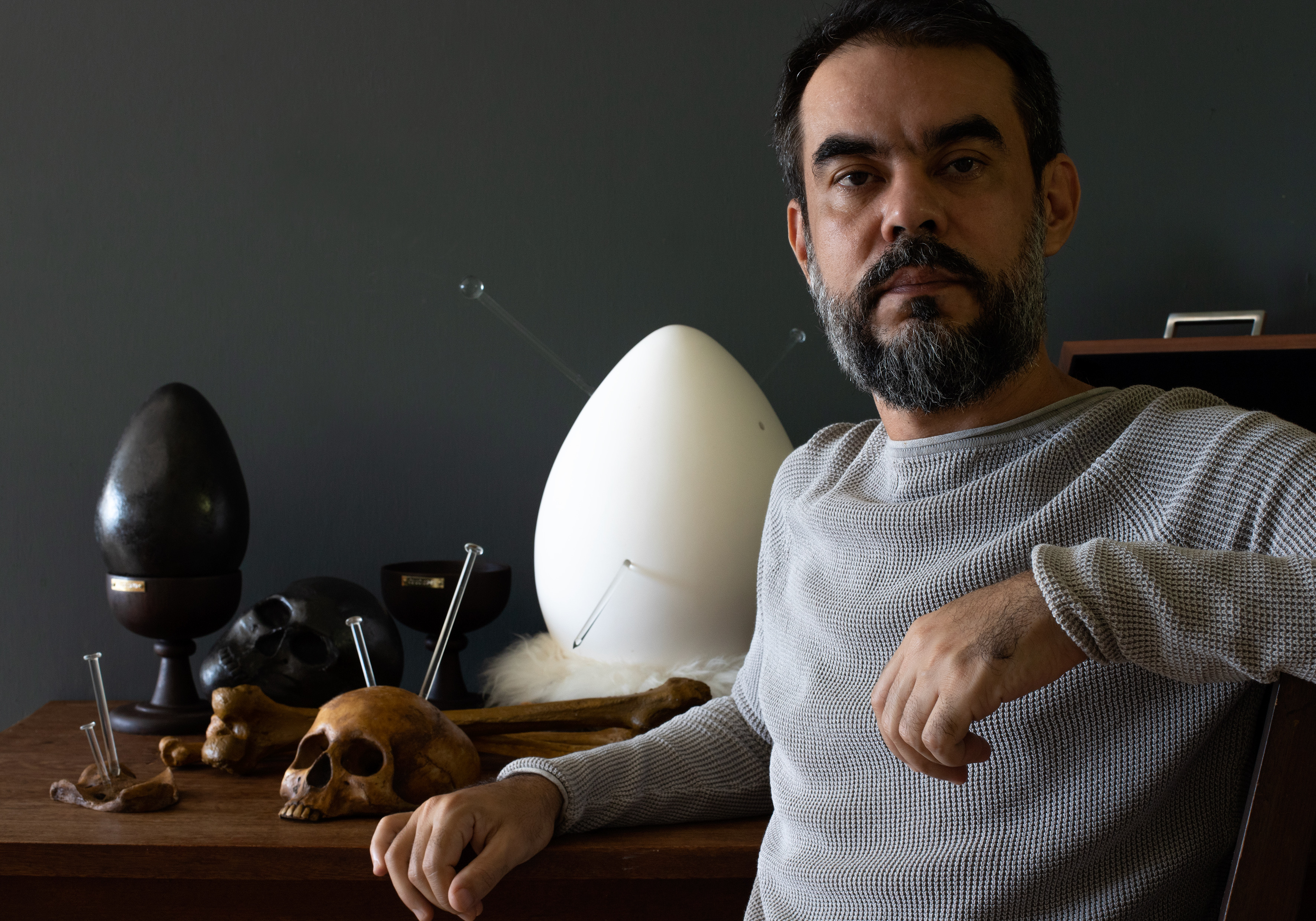
FÁBIO MAGALHÃES
Fábio Magalhães (1982, Tanque Novo – BA) lives and works in Salvador. He builds his poetics through investigations related to human conditions, which serve as a starting point for the creation of visual metaphors in images, objects, and installations. His artistic thinking is always in dialogue with painting, even when producing three-dimensional works. The artist meticulously stages scenes that blur the boundaries of perception and stir unrest about reality. To this end, Fábio brings together a set of conceptual, historical, and procedural operations of art to create works that go beyond the ordinary and seek to awaken a dormant human consciousness. His work explores a coexistence of ambivalence between otherness and the particularities of human relationships, through metaphors drawn from impulses, psychic conditions, and the substrata of a personal imaginary.
Throughout his career, the artist has held several solo exhibitions, including O grande corpo (The Great Body), 2011, recipient of the Matilde Mattos/FUNCEB Award (Galeria do Conselho, Salvador/BA), and Além do visível, aquém do intangível (Beyond the Visible, Beneath the Intangible), 2016, curated by Alejandra Muñoz (Museu de Arte da Bahia, Salvador/BA), which later toured Caixa Cultural in São Paulo (2017) and Brasília (2018). In 2011, he received the FUNARTE Contemporary Art/Northeast Room Award. He was selected for Rumos Itaú Cultural 2011/2013 and, in 2015, was nominated for the PIPA Prize. His work has also been featured in group exhibitions such as Convite à viagem – Rumos Artes Visuais 2011/2013, 2012 (Itaú Cultural, São Paulo/SP); O fio do abismo – Rumos Artes Visuais 2011/2013, 2012 (Belém/PA); Territórios, 2012 (Sala FUNARTE/Northeast, Recife/PE); and Espelho Refletido, 2012 (Centro Cultural Hélio Oiticica, Rio de Janeiro/RJ). He also participated in the group show Contraponto – Coleção Sérgio Carvalho, 2017 (Museu Nacional de Brasília/DF), and 50 anos de realismo: do fotorrealismo à realidade virtual (50 Years of Realism: From Photorealism to Virtual Reality), 2018–2019, a traveling exhibition (Centro Cultural Banco do Brasil in São Paulo/SP, Brasília/DF, and Rio de Janeiro/RJ).
Fábio Magalhães (1982, Tanque Novo – BA) lives and works in Salvador. He builds his poetics through investigations related to human conditions, which serve as a starting point for the creation of visual metaphors in images, objects, and installations. His artistic thinking is always in dialogue with painting, even when producing three-dimensional works. The artist meticulously stages scenes that blur the boundaries of perception and stir unrest about reality. To this end, Fábio brings together a set of conceptual, historical, and procedural operations of art to create works that go beyond the ordinary and seek to awaken a dormant human consciousness. His work explores a coexistence of ambivalence between otherness and the particularities of human relationships, through metaphors drawn from impulses, psychic conditions, and the substrata of a personal imaginary.
Throughout his career, the artist has held several solo exhibitions, including O grande corpo (The Great Body), 2011, recipient of the Matilde Mattos/FUNCEB Award (Galeria do Conselho, Salvador/BA), and Além do visível, aquém do intangível (Beyond the Visible, Beneath the Intangible), 2016, curated by Alejandra Muñoz (Museu de Arte da Bahia, Salvador/BA), which later toured Caixa Cultural in São Paulo (2017) and Brasília (2018). In 2011, he received the FUNARTE Contemporary Art/Northeast Room Award. He was selected for Rumos Itaú Cultural 2011/2013 and, in 2015, was nominated for the PIPA Prize. His work has also been featured in group exhibitions such as Convite à viagem – Rumos Artes Visuais 2011/2013, 2012 (Itaú Cultural, São Paulo/SP); O fio do abismo – Rumos Artes Visuais 2011/2013, 2012 (Belém/PA); Territórios, 2012 (Sala FUNARTE/Northeast, Recife/PE); and Espelho Refletido, 2012 (Centro Cultural Hélio Oiticica, Rio de Janeiro/RJ). He also participated in the group show Contraponto – Coleção Sérgio Carvalho, 2017 (Museu Nacional de Brasília/DF), and 50 anos de realismo: do fotorrealismo à realidade virtual (50 Years of Realism: From Photorealism to Virtual Reality), 2018–2019, a traveling exhibition (Centro Cultural Banco do Brasil in São Paulo/SP, Brasília/DF, and Rio de Janeiro/RJ).
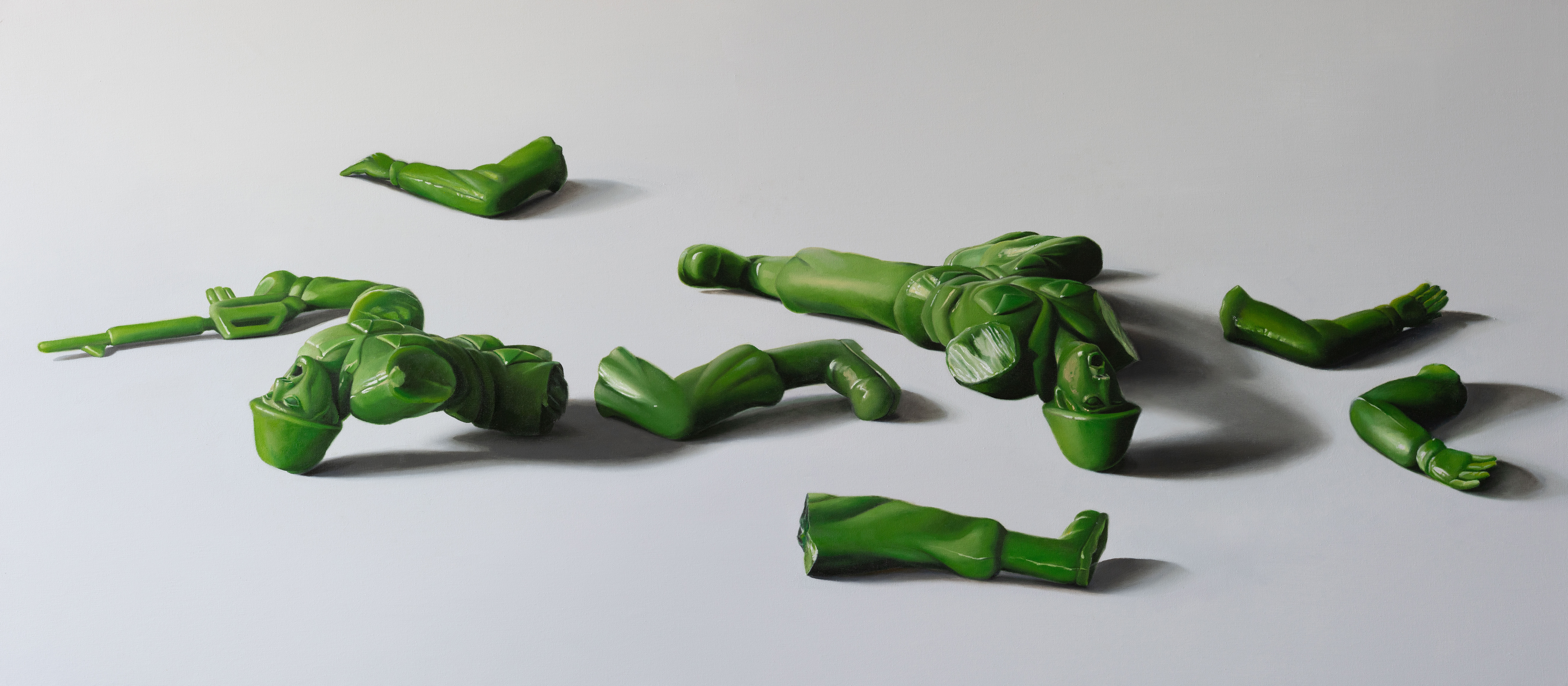


"The idea of painting as a sensitive body, as skin in the process of incarnation, can be found both in recent works and in earlier ones. As a mechanism of understanding, Fábio Magalhães tells us that he develops “metaphors created from drives, psychic conditions, and the substrata of a personal imaginary, until reaching a state (...) Image/Body.” But painting is, inevitably, body. This awareness was given to us by Rembrandt, Cézanne, Rothko, Pollock, Fontana, and Lygia Clark. The latter declared the death of painting as representation only to then create surfaces of contact, devices for self-knowledge. Magalhães’s works seem to affirm that it is still possible to treat painting as a surface of tactility. For such an endeavor, the artist reintroduces retinal vision, almost preventing us from noticing the porosity of the brushstroke, the uncertainty of the lines, the limits of illusion."
Marcelo Campos
"Fábio Magalhães is a contemporary of a young Brazilian generation of painting—vigorous and visceral—that expresses the potential of the medium beyond its fibrous materiality. In general, this generation conceives the very artistic object of painting as an immeasurable spatial reality, at times a powerful installational painting that redefines the space in which it is exhibited. It is a generation of artists that repositions figurative painting, at times bordering on iconoclasm with regard to the traditional genres of portraiture, still life, and landscape. Armed with technical virtuosity, this is a kind of painting that dismantles the factual and the anecdotal to reveal unsettling aspects of everyday life, taboos, and psychic universes that often operate like a vortex upon the viewer."
Alejandra Muñoz
Marcelo Campos
"Fábio Magalhães is a contemporary of a young Brazilian generation of painting—vigorous and visceral—that expresses the potential of the medium beyond its fibrous materiality. In general, this generation conceives the very artistic object of painting as an immeasurable spatial reality, at times a powerful installational painting that redefines the space in which it is exhibited. It is a generation of artists that repositions figurative painting, at times bordering on iconoclasm with regard to the traditional genres of portraiture, still life, and landscape. Armed with technical virtuosity, this is a kind of painting that dismantles the factual and the anecdotal to reveal unsettling aspects of everyday life, taboos, and psychic universes that often operate like a vortex upon the viewer."
Alejandra Muñoz
“Anyone who resorts to such a traditional medium is always haunted by the risk that technical skill might overshadow the subjective qualities of painting. In Fábio’s case, the artist creates a sensory experience in which technique and poetics are complementary. It’s impossible not to be struck by the precision of the painting; it’s impossible not to react with the heart. Our eyes pulse before this flesh-subject: dilation and contraction (systole and diastole) are the movements provoked by the force of these images that seize us."
Gabriela Motta
“The synthesis of the work operates in a reality far beyond the real, one that makes use of the illusory—of trompe-l’œil—as an instrument of pictorial meditation. The word meditation should not be understood as a metaphor or generality. It is essential to the generative processes of creation. The artist explains that, in order to arrive at his powerful canvases, he first stages a scene—a true performance—which is then photographed. He selects three of these photos and brings them together, transfiguring them through painting. Painting prevails, therefore, as the performance is ephemeral, and the photographs vanish, either destroyed or sent to an inaccessible archive. Everything resolves into pure painting…”
Jorge Coli
Gabriela Motta
“The synthesis of the work operates in a reality far beyond the real, one that makes use of the illusory—of trompe-l’œil—as an instrument of pictorial meditation. The word meditation should not be understood as a metaphor or generality. It is essential to the generative processes of creation. The artist explains that, in order to arrive at his powerful canvases, he first stages a scene—a true performance—which is then photographed. He selects three of these photos and brings them together, transfiguring them through painting. Painting prevails, therefore, as the performance is ephemeral, and the photographs vanish, either destroyed or sent to an inaccessible archive. Everything resolves into pure painting…”
Jorge Coli
Fábio Magalhães (1982, Tanque Novo – BA) lives and works in Salvador. He builds his poetics through investigations related to human conditions, which serve as a starting point for the creation of visual metaphors in images, objects, and installations. His artistic thinking is always in dialogue with painting, even when producing three-dimensional works. The artist meticulously stages scenes that blur the boundaries of perception and stir unrest about reality. To this end, Fábio brings together a set of conceptual, historical, and procedural operations of art to create works that go beyond the ordinary and seek to awaken a dormant human consciousness. His work explores a coexistence of ambivalence between otherness and the particularities of human relationships, through metaphors drawn from impulses, psychic conditions, and the substrata of a personal imaginary.